
Why Kingdom Work Needs Good Records
Effective ministry requires more than passion, it needs structure. Good records help faith-based organizations track engagement, support spiritual growth, and steward people with intention. From prayer attendance to Bible study participation, data reveals patterns that guide outreach and accountability. When used wisely, records don’t replace the Holy Spirit' they partner with Him to build stronger, more responsive communities.

How do you measure spiritual growth without reducing it to a checklist? That question came to me earlier this year when I was asked to help build an attendance tracker for the Christian Women’s Network to which I belong—a platform that raises women for kingdom leadership, societal significance, and generational impact.

As part of our activities, we meet daily to pray, study the Word of God, and engage in other spiritual exercises. But one of the things that makes our network unique is our emphasis on accountability. Accountability is central to our mission: no woman should remain a passive bystander. Each woman should be growing, rooted, and thriving.
Some would say, “That’s the work of the Holy Spirit.” And they would be right. But the Holy Spirit often works through structures, reminders, and accountability that keep us focused and intentional.
That’s where data becomes more than just numbers. It becomes a mirror.
When we track how often someone joins prayer, studies the Bible, or engages with her team, we are not trying to control spiritual growth—we are creating space for honest reflection. Sometimes the data nudges us before the sermon even does. Seeing that you’ve missed more prayer meetings than you realized, or that you haven’t engaged in Bible study for weeks, can serve as a gentle nudge to realign.
In that way, data doesn’t compete with the Holy Spirit—it partners with Him by revealing patterns we might otherwise ignore.
This is not new to the faith. Scripture itself is full of moments where God’s people were counted, recorded, and held accountable. From the census of Israel in Numbers, to the book of Acts noting “about three thousand were added” (Acts 2:41), data was used to show growth, faithfulness, and sometimes even disobedience. The numbers were never the goal, but they were a witness.
Over the years, we’ve tried different methods to keep track, including WhatsApp polls and Google Sheets, both manual and automated. Each method had its merits, but none gave us the clarity and ease we needed. That’s when we discovered Airtable.
What is Airtable?
Airtable is a cloud-based platform that combines the simplicity of a spreadsheet with the power of a database. It allows teams to organize, filter, and visualize information in ways that are easy to understand—even for those with little technical experience. It’s flexible, visual, and collaborative, making it ideal for tracking more than just numbers.onal transformation disguised as a hike.

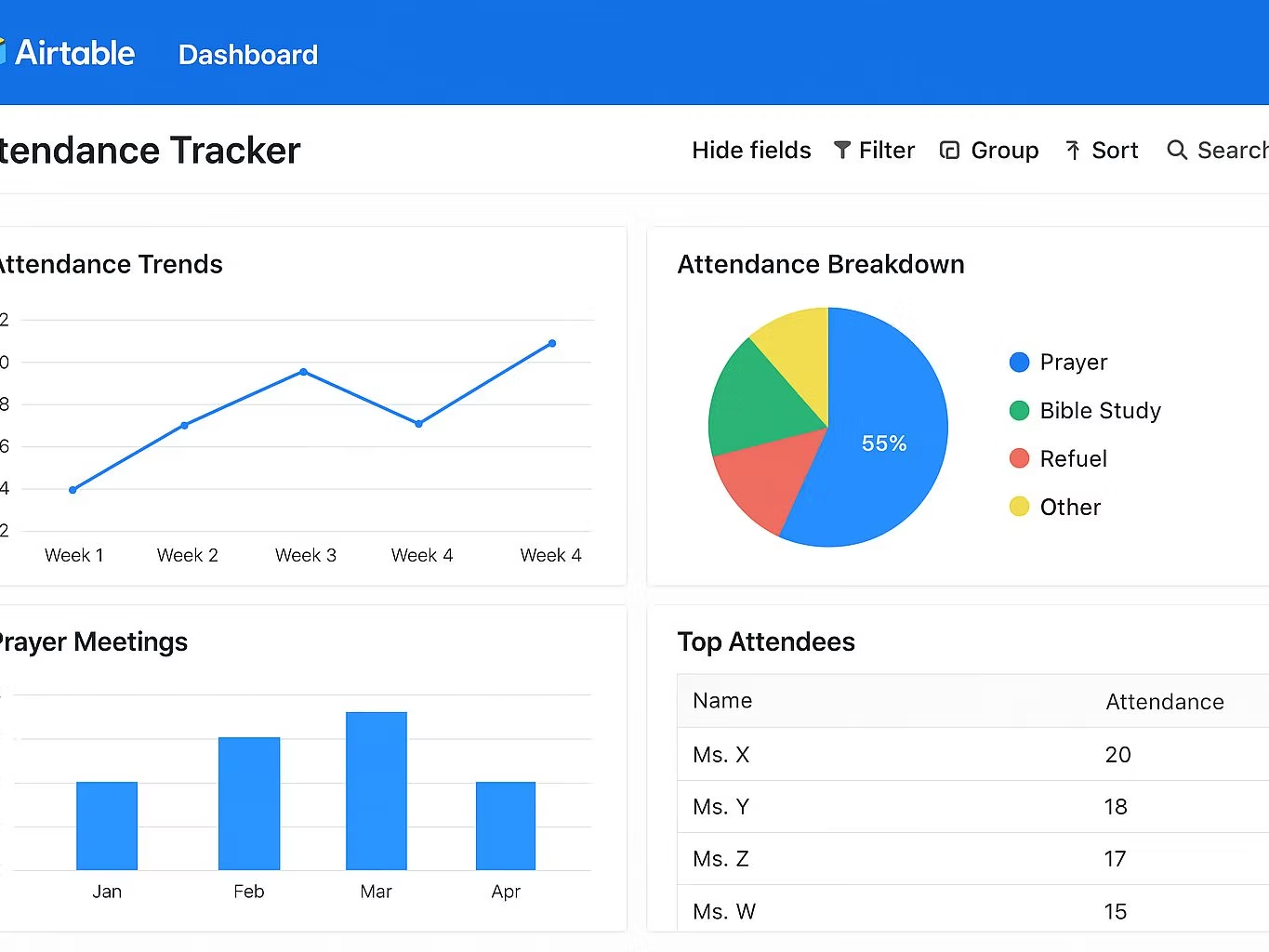
This is a sample dashboard not the actual dashboard we built. Disclaimer: This post is not associated with or endorsed by Airtable.
With Airtable, we can quickly see who hasn’t checked in for a couple of weeks, who consistently joins prayer, and who is engaging with her team. And here’s the beautiful part: this visibility allows us to reach out personally—not to scold, but to support. Because of it, we can pray more intentionally, encourage more personally, and support each other more meaningfully.
The lesson I’ve learned is this: data matters in faith spaces because people matter. Without it, some may slip through the cracks unnoticed. With it, we can steward better, love better, and serve better.

Think of it this way: Jesus fed the 5,000, and someone cared enough to count. That detail didn’t make the miracle; it revealed the scale of God’s abundance. Data, when surrendered to God, does the same thing—it helps us trace His fingerprints more clearly in our work.
The Holy Spirit convicts, but He also calls us to be wise builders and faithful stewards. And sometimes, stewardship looks like spreadsheets and dashboards.
Reflection Question:
What practical tools, if any, have helped you stay spiritually accountable—and how do you make sure those tools remain helpful and not a burden?
With Love
Andrea (Kashie)